Credential leaks most often surface in criminal trading — long before the victim notices any damage. This review ranks eight second-tier darknet mini-markets — Nexus, Moomin, TorZon, Mars, Flugs 4.0, Prime, Catharsis, and Wtn — by criminal function, documented impact, and significance for threat intelligence: where activity flows after the giants are shut down, and what each platform reveals about the nature of cybercrime.
This article deliberately does not publish links, addresses, mirrors, or ways to access any marketplace. All information has been gathered from open sources: law enforcement publications, cybersecurity company reports, and public research. The material is intended for information security professionals, analysts, journalists, and anyone who wants to understand how the criminal ecosystem works in order to defend against it.
What Are Dark Web Marketplaces?
Dark Web marketplaces are hidden trading platforms operating within anonymity networks, hosting illegal goods, stolen data, fraud tools, and cybercriminal services. You cannot reach them with a regular browser, and their entire infrastructure is built to conceal users’ identities, server locations, and money flows.
On the surface, many of them are almost indistinguishable from ordinary online stores: product cards, vendor profiles, search filters, reviews, escrow accounts, and a dispute resolution system. The familiar “storefront” mechanics simplify the organization of criminal trade, but behind the interface there is no legal protection, no verified identities, and no real accountability.
Cryptocurrency payments and reputation ratings create a working trust model, but the system remains fragile. Exit scams, arrests of administrators, server seizures, vendor fraud, and plain operational mistakes can bring a marketplace down at any moment — without warning and without refunding anyone.
In short
A darknet marketplace is a hidden trading platform inside an anonymity network — storefront mechanics borrowed from ordinary e-commerce, but with no legal protection, no verified identities, and no real accountability.
How Did We Prepare This Review for Dark Web markets?
The review of onion markets is based on public law enforcement releases, court materials, government alerts, cybersecurity company reports, and threat intelligence research. We did not visit any marketplace, create accounts, test purchases, or verify links — and we advise no one else to do so.
The assessment was built around documented criminal function, reported activity, incident history, data types, and connection to real-world harm. Reports linking a marketplace to payment fraud, credential theft, money laundering, and initial access trading carried more weight than name recognition.
The ranking prioritizes research significance over popularity, uptime, or underground reputation. A platform made the list only where public evidence explains why it matters for SOC teams, anti-fraud analysts, banks, and threat intelligence programs in 2026.
1
Documented criminal function
What the platform is actually used to trade, according to public reporting.
2
Reported activity
Signals described in cybersecurity research and public monitoring.
3
Incident history
Closures, seizures, relaunches, and scam allegations on record.
4
Data types
Credentials, accounts, access, documents, and fraud tooling.
The Dark Web platforms below are evaluated by criminal function, documented impact, and significance for threat intelligence — not by accessibility, “security,” or underground popularity. Each review relies solely on open-source reporting: nothing here was verified by visiting, registering on, or transacting with any platform.
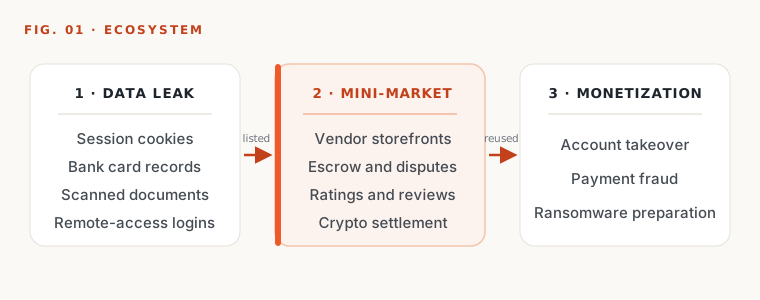
The underground trade ecosystem: from data leak to monetization. A session cookie, a bank card record, or a scanned document travels from a vendor’s storefront to account takeover, fraudulent payments, or the preparation of a ransomware attack.
#1NEXUS
Nexus Market
Universal market · Mixed catalog · escrow
Monitor forCTI analysts — migrating vendor demand
Nexus Market is a typical representative of the new wave of universal mini-markets: the platform gathers vendors who have left shut-down giants and offers them the usual set — product cards, escrow, ratings, and built-in exchangers. According to open researcher data, the catalog combines digital goods, databases, fraud tools, and a physical contraband segment.
For analysts, Nexus is interesting as a “collection point” for migrating demand: when a major market falls, it is precisely on such universal platforms that vendor storefronts recover fastest. Tracking the appearance of well-known vendor aliases here helps to understand where the criminal supply chain flows after the next takedown.
Who should monitor: CTI analysts tracking how vendor demand migrates after takedowns.
Open-source reporting only
#2MOOMIN
Moomin Market
Niche mini-market · Digital goods
Monitor forDarknet researchers — quiet batches
Moomin Market belongs to the category of small niche platforms that rarely appear in the mainstream press but consistently feature in researcher monitoring. According to public reports, the platform’s emphasis is on digital goods: accounts, access credentials, various data sets, and related fraud materials.
The value of such mini-markets for defenders lies in the “quiet” nature of their activity. A small influx of users means less noise, but no less risk: batches of stolen accounts can be sold for months without public attention. Teams doing leak monitoring include such platforms in their perimeter precisely because of this “invisibility” effect.
Who should monitor: Darknet researchers and leak-monitoring teams watching low-noise sales of stolen accounts.
TorZon Market stands out not so much for its assortment as for its resilience. The platform has survived several waves of outages, DDoS attacks, and trust crises, each time returning through rotation of entry points and mirrors. For infrastructure analysts, it is a classic “barometer” of market health: downtime, mirror movement, and vendor discussions reveal whether trust in the platform is growing, cracking, or already relocating elsewhere.
According to open data, listings include compromised credentials, fraud tools, hacking services, and a physical contraband segment — the full spectrum of typical darknet demand. Researchers read TorZon’s infrastructure just as closely as the listings themselves: a platform’s resilience to failures says a lot about its operators’ professionalism.
Who should monitor: Infrastructure analysts reading downtime, mirror movement, and trust dynamics.
Open-source reporting only
#4MARS
Mars Market
Newcomer platform · Vendor migration
Monitor forThreat researchers — early signals
Mars Market is a relatively young name on the darknet map, and the body of evidence on it is still thinner than on older platforms. It is more honest to call it not an “established hub” but a “watchlist name”: it is precisely such new markets that surface right after server seizures, exit scams, or a collapse of trust somewhere else.
A thin evidence base is not an absence of signal. Threat researchers track Mars Market because vendor migration patterns on such platforms hint at where demand is moving before reports are even written about it. For threat intelligence, an established vendor’s early appearance on a new market is a leading indicator of the entire ecosystem restructuring.
Who should monitor: Threat researchers treating early vendor migration as a leading indicator.
Open-source reporting only
#5FLUGS 4.0
Flugs 4.0 Market
Regional platform · Scandinavian segment
Monitor forRegional investigators — local trade
Flugs 4.0 Market reads differently because it is local. The name and version numbering indicate continuity with a line of regional platforms historically oriented toward the Scandinavian segment: local demand, local vendors, internal logistics. The “4.0” number is itself a marker of how many times the project has been relaunched after failures and pressure.
The regional angle surfaces where global monitoring is blind: the language of listings, the geography of buyers, local delivery routes. A small footprint does not mean small risk — domestic circulation reduces cross-border friction and makes detection harder, not easier. This is precisely why regional markets fall within the monitoring perimeter of anti-fraud and identity-risk teams in the respective countries.
Who should monitor: Regional investigators monitoring domestic circulation and local delivery routes.
Open-source reporting only
#6PRIME
Prime Market
Digital goods · Accounts · logs · tools
Monitor forAnti-fraud teams — session reuse
According to open monitoring data, Prime Market concentrates on the digital segment: stolen accounts, stealer logs, access to services, and fraud tooling. Such specialization makes the platform a link in the chain “infected device → account takeover → financial damage.”
The main threat of this segment is speed. Valid sessions and cookies from logs allow bypassing password checks long before the victim notices anything, which directly undermines trust in MFA and account recovery procedures. Anti-fraud and IAM teams watch such markets because active sessions start being reused within the first hours after a log is published.
Who should monitor: Anti-fraud and IAM teams defending against session and cookie reuse.
Open-source reporting only
#7CATHARSIS
Catharsis Market
Closed community · Invite model
Monitor forClosed-network analysts — alias overlap
Catharsis Market represents another type of mini-market — a platform with elements of a closed community. According to open accounts, access and vendor status there are regulated more strictly than on open markets: invites, vendor screening, a narrow circle of trusted participants. Such a model reduces noise and the amount of scam, but makes the platform almost opaque to outside observers.
For analysts, closed markets are the hardest object of study: little public data is available, and signals have to be gathered from indirect signs — forum mentions, vendor migrations, alias overlaps. Yet, as investigative practice shows, it is precisely in closed circles that the most “premium” criminal goods tend to surface: fresh databases, exclusive access, expensive services.
Who should monitor: Closed-network analysts piecing together indirect signals from forums and alias overlaps.
Closing the list is Wtn Market — a broad-profile mini-market with a small but, according to researcher observations, consistently maintained catalog. The platform does not aspire to the scale of market leaders, yet it is precisely such “quiet” markets that live longer: less press attention, lower priority for law enforcement, a loyal core of vendors.
For SOC teams and leak monitoring services, Wtn Market is interesting as a background risk source: data appearing here may go unduplicated on major platforms for weeks, and missing it means losing response time. The lesson is simple: the monitoring perimeter must not be limited to loud names alone.
Who should monitor: SOC teams and leak monitoring services covering quiet, long-lived background risk.
Open-source reporting only
How Are Darknet Marketplaces Usually Structured?
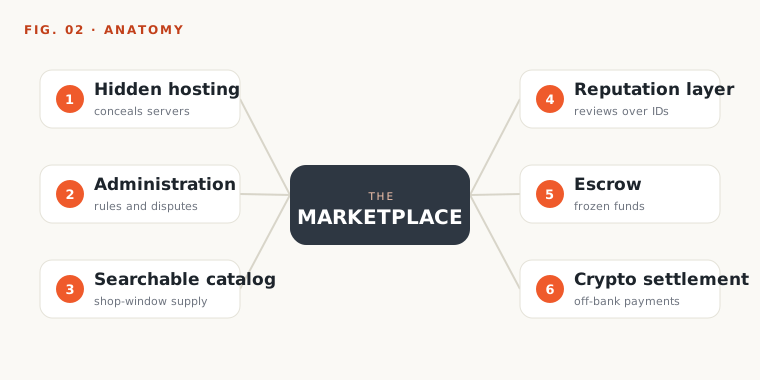
A Dark Web marketplace works like an underground store thanks to six moving parts: hidden hosting, central administration, a searchable catalog, a reputation layer, escrow mechanics, and cryptocurrency settlement. Each element plays its role in keeping the platform running — and each is also a point of failure.
The six components that make up a typical darknet marketplace. Every element keeps the platform running — and every element is also a point of failure.
1
Hidden hosting
Anonymity networks conceal server locations, making direct attribution difficult for investigators — but simultaneously creating chaos during outages: cloned pages, phishing copies, scams, and fake “mirrors.”
2
Central administration
Administrators control registrations, vendor admission, listing rules, commissions, and disputes. A single arrest, hack, or exit scam can destroy trust in the entire platform within hours.
3
Searchable catalog
Vendors arrange stolen data, fraud kits, documents, and cyber services into “product” categories, turning illegal supply into a convenient, comparable, shop-window format.
4
Reputation layer
Reviews and transaction history replace identity verification. Inflated ratings, paid promotion, or a vendor’s sudden disappearance turn trust signals into a trap.
5
Escrow
Funds are frozen until delivery is confirmed. This reduces direct buyer fraud, but creates a centralized money pool that can itself be stolen, frozen, or seized.
6
Cryptocurrency settlement
Digital currencies bypass banks and standard payment controls, yet wallet reuse, laundering mistakes, and blockchain analytics can still reconstruct the money trail.
This system almost never fails “gently.” A law enforcement operation, exposure of infrastructure, theft by an administrator, or a simple loss of trust can bring a market down without warning — after which activity usually flows to mirrors, forums, private channels, or an entirely new platform.
Why Do Darknet Marketplaces Change So Often links?
Short answer
Because criminal trust, hidden infrastructure, law enforcement pressure, and control over money rarely remain stable for long.
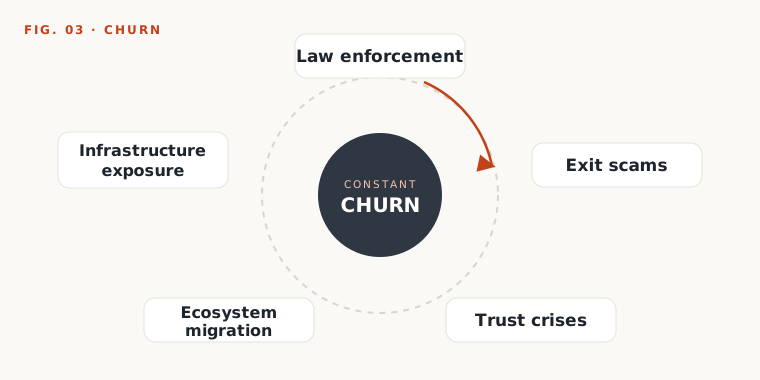
Five forces that make markets disappear and be reborn. After every collapse, criminal supply chains keep working — only the names, addresses, and communities change.
1
Law enforcement pressure
Investigations can proceed invisibly for months before arrests, server seizures, or domain takedowns become public. A single high-profile operation can push users toward mirrors, private forums, or new platforms.
2
Exit scams
Platform owners control escrow balances, vendor deposits, and internal wallets. Once enough funds accumulate, some operators disappear without warning, leaving buyers and vendors with no path to recovery whatsoever.
3
Infrastructure exposure
Servers, hosting providers, payment channels, and communication accounts can reveal weak points. Small configuration mistakes turn a hidden service into a target — for investigators or for competitors.
4
Trust crises
Underground trade rests on reputation more than on formal protection. Fake reviews, withdrawal delays, vendor fraud, and rumors of compromise can drain activity long before any official shutdown.
5
Ecosystem migration
After a collapse, displaced users typically flow to forums, Telegram channels, invite groups, or successor platforms. Criminal supply chains keep working — only the names, addresses, and communities change.
What Risks Are Associated with Darknet Marketplaces?
Participation in such spaces carries risks that outlive the marketplace itself:
Legal consequences — criminal investigation, prosecution, asset seizure, or long-term surveillance even for limited participation: accounts, correspondence, payments, and devices all leave digital traces.
Financial losses — escrow balances, crypto wallets, and paid orders can vanish in an exit scam or a sudden shutdown, with no formal recourse for recovery.
Identity exposure — reused nicknames, poor device hygiene, or compromised infrastructure can link online activity to a real person, especially after law enforcement intervention.
Data abuse — private messages, order histories, and wallet details can be copied, leaked, or seized, and information stored by a collapsed platform can resurface later in another underground channel.
Trust manipulation — reviews, ratings, and vendor reputations can be fabricated or abandoned at any moment, and the signals participants rely on are sometimes controlled by scammers, insiders, or undercover operations.
The broader threat extends beyond any individual buyer or vendor. Stolen credentials, card records, and documents traded here flow directly into account takeovers, payment fraud, and ransomware preparation. For organizations, the real damage is not the marketplace itself, but what the exposed data enables after a leak.
How Do Law Enforcement Agencies Affect Market Stability?
Law enforcement weakens these platforms by striking at four targets at once: infrastructure, payments, identities, and the trust that holds the ecosystem together.
Most of the real work happens before anyone notices. Agencies often quietly watch a trading platform for months, mapping vendor accounts, communication channels, wallet movements, and seller–buyer connections long before any public arrest or seizure. When the operation finally comes — whether a server takedown, a domain seizure, or an operator arrest — it can cut off access without warning and trigger quiet escapes and emergency migrations, sometimes with funds stolen in panic even before any public announcement.
Cryptocurrency does not fully protect operators. Wallet reuse, exchange deposits, and laundering mistakes leave a traceable path that blockchain analytics can connect to cash-out points or real identities. And the damage from a major takedown rarely stays confined to one platform: rumors of compromise or undercover work shake trust on neighboring forums and in vendor communities, pushing displaced users toward the next “safer” alternative rather than out of the ecosystem entirely.
How Do Cybersecurity Analysts Evaluate Darknet Markets list?
Analysts evaluate darknet marketplaces through public evidence, observable patterns, and risk context — without direct participation or transactional activity.
1
Public evidence
Law enforcement releases, court materials, cybersecurity reports, breach research, and historical records — reducing legal risk while showing how a marketplace figures in fraud and access trading.
2
Activity history
Uptime patterns, past closures, scam allegations, vendor movements, and user migrations help assess stability.
3
Infrastructure changes
Mirror movements, domain seizures, hosting outages, and channel switches can reveal pressure around an underground site.
4
Money movement
Wallet behavior, cash-out routes, escrow complaints, and laundering mentions expose stress inside the criminal economy.
5
Risk context
Findings are tied to account takeover, payment fraud, ransomware entry points, identity abuse, and brand threats — turning underground observations into defensive actions.
Darknet Marketplaces 2026: Key Takeaways
Darknet marketplaces of 2026 are better understood as unstable criminal supply chains than as permanent online destinations. Their value for defenders lies in the clues they leave around stolen credentials, payment card abuse, laundering routes, regional trade, and initial access material.
Mini-markets like those reviewed in this article are especially telling: names, uptime claims, and underground reputation can change within weeks after seizures, scams, arrests, or user migrations. Strong analysis looks at documented impact, incident history, and the type of business harm associated with each category.
Key takeaway
For SOC teams, anti-fraud units, banks, and threat intelligence programs, the true priority is early visibility. Monitoring underground activity helps connect leaked data to account takeover, financial losses, ransomware preparation, and broader exposure — before those risks turn into incidents.
Darknet Marketplaces: Frequently Asked Questions
Are darknet marketplaces legal?
Not automatically, but many are used to trade stolen data, fraud tools, and other illegal materials. Buying, selling, or knowingly participating can lead to a criminal investigation.
Why are darknet marketplaces risky even for buyers?
Funds can disappear through an exit scam or frozen escrow, and buyers leave traces through correspondence, wallets, and device configuration mistakes.
Why do darknet market rankings differ between sources?
Researchers measure different things: historical impact, transaction volume, or threat intelligence significance. A platform can be important for analysis even if its current status is unclear.
Does cryptocurrency make darknet transactions anonymous?
No. Wallet reuse, exchange deposits, and blockchain tracing can still link transactions to real identities.
What should a business do if its data appears on a darknet marketplace?
Verify the leak, reset credentials, revoke active sessions, check logs for signs of abuse, and engage lawyers or an incident response team.
Why are there no links to the marketplaces in this article?
This is a matter of principle. We publish this material exclusively for education and defense: links, addresses, and mirrors do not help defend — they help visit. Everything needed for threat analysis is available in public reports and research.
Methodology and Sources
Methodology
This review is based on public law enforcement releases, court materials, government alerts, cybersecurity company reports, and threat intelligence research. We did not visit any marketplace, create accounts, make test purchases, or verify links — and we advise no one else to do so. Marketplace names are mentioned exclusively for research purposes; there are no links to darknet resources in this article, and there never will be.
Open-source reporting onlyNo links or mirrors publishedUpdated September 2026